


A water meter still ticking with every tap shut means the national leakage figures include your pipe. Vision Plumbing carries out Leak Detection across Kent, Medway, Surrey, East Sussex, West Sussex and south-east London, finding the leak before a floor or drive is opened.
The Quick Answer
- Daily leakage across England and Wales and the share of water pumped
- Why Scotland and Northern Ireland lose more per person per day
- How night flow and rolling averages produce the published figures
- A meter and stopcock test that shows whether the leak is yours
Vision Plumbing is a sole trader plumbing, drainage and hot water business: the plumber who quotes the job is the plumber who turns up and does it. Need a leak detection at home, or are you a landlord looking for water leak detection in Maidstone? We cover the whole area.
Get a quick quote from Vision Plumbing and have the leak pinpointed across Kent, Medway, Surrey, East Sussex, West Sussex and south-east London before another bill arrives.
What are the current statistics on water leakage in the UK?
The current statistics on water leakage in the UK show England and Wales losing about 2,869 million litres a day, roughly a fifth of water pumped, with Scotland and Northern Ireland above 80 litres per person per day. Ofwat records an 11% cut since 2017 to 2018 and plans 17% more by 2030.
Get a quick quote from Vision Plumbing and have the leak on your side of the meter found before a single floorboard comes up.
What you can check yourself, and what needs a specialist
The national leakage figures fall into two parts, and one of them is yours. Customer supply-pipe leakage is water lost from the private pipe that runs from the boundary stopcock or meter into the house. In most homes that length of pipe belongs to the property owner, not the water supplier, and a lot of what you need to know about it you can find out without any tools.
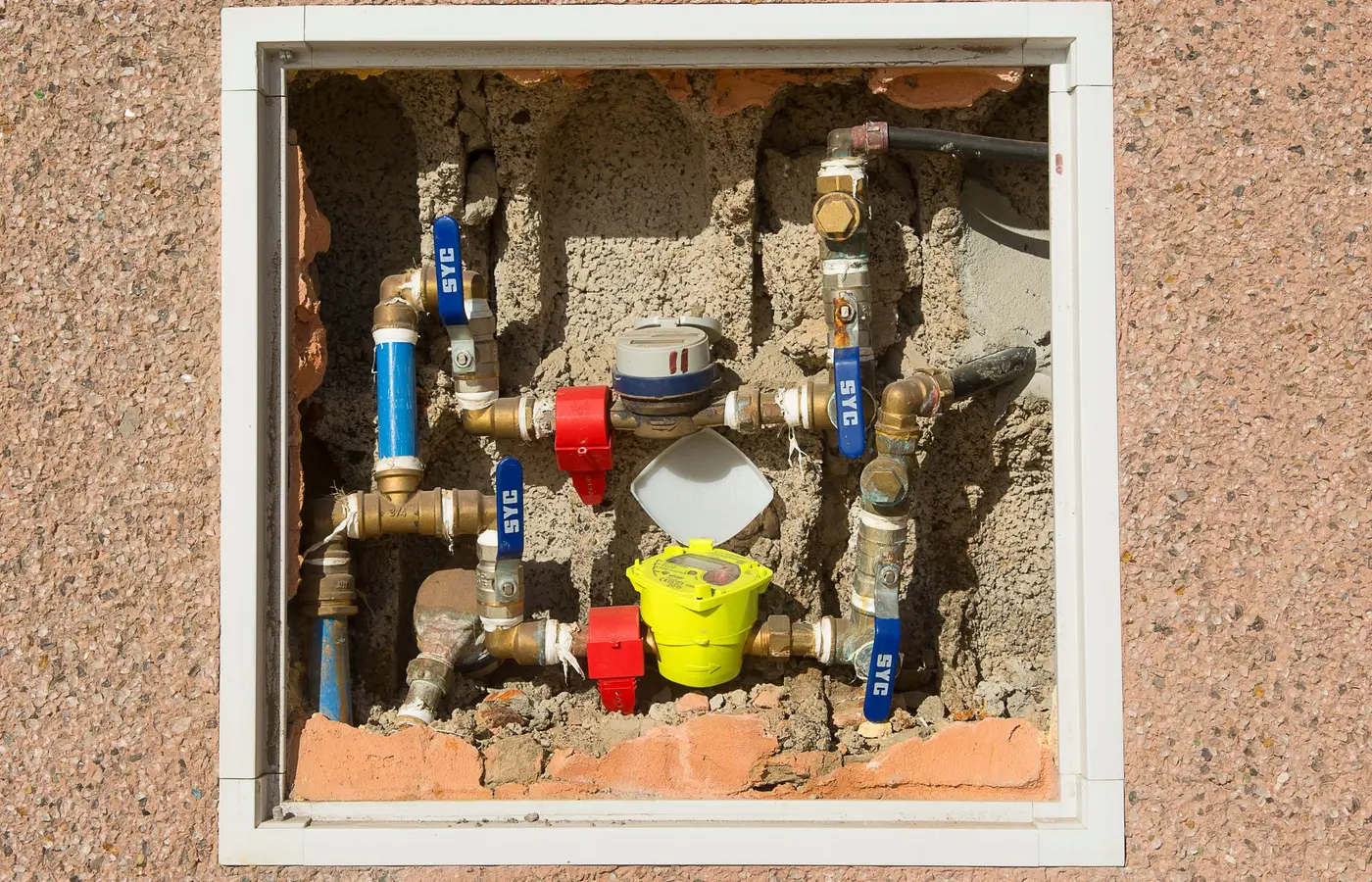
- The meter test. Close every tap, check nothing is filling (a cistern, washing machine or dishwasher), read the meter, then use no water for a good while, ideally overnight, and read it again. Any movement means water is going somewhere.
- The stopcock test. If the meter moved, close the internal stopcock and repeat. If it still moves, the leak is probably on the buried supply pipe between the meter and the house.
- The cistern test. Put a few drops of food colouring in the toilet cistern. Colour in the pan without a flush means a leaking flush valve, one of the commonest hidden losses in a house.
- The visual check. Look under sinks, behind appliances, around the hot water cylinder and at the stopcock itself for drips, staining or green corrosion.
Where you stop is the point the pipe disappears. Once a leak is under a floor, inside a wall, beneath a drive or below a concrete slab, guessing costs you plaster, floorboards and paving. That is the job for proper leak detection: thermal imaging and acoustic tracing narrow the run down to a single point before anything is opened.
How long a leak search takes and the disruption to expect
There is no single duration for finding a leak, because the pipe decides it more than the method does. These are the things that make one search quick and another slow:
- The length and depth of the pipe run, and whether anybody knows its route
- What sits on top of it: a suspended timber floor, a screeded floor, block paving or tarmac
- Background noise from traffic, pumps and appliances, which acoustic tracing has to listen through
- Whether sections of pipe can be isolated and pressure-tested on their own
- Hot or cold: a leaking hot water pipe shows on a thermal camera far more readily than a cold main buried in clay
The disruption is lighter than most people expect. A non-destructive survey means a thermal camera, a ground microphone and the water turned off for short spells while sections are checked. Nothing comes up until the leak is pinpointed, so the repair opening is usually one small hole or a single lifted board, not a trench dug on a hunch along the whole route.

How the leakage figures are measured, step by step
Nobody can watch 2.87 billion litres per day disappear, so the national figures are built up from flow measurement. The method matters, because it explains why the numbers move the way they do.
- Flow is metered into small zones. Networks are divided into district metered areas, each with a meter recording what goes in.
- Night flow is read. In the small hours legitimate use falls close to its minimum, so most of what still flows is leakage.
- Expected night use is subtracted. An allowance for overnight use by homes and businesses comes off, and the remainder is the leakage estimate.
- The total is split. Distribution-system leakage is lost from mains and company pipes; customer supply-pipe leakage is lost from private pipes on the property side.
- Results are averaged. Performance is judged on a three-year rolling average, so one hard winter of freeze and thaw bursts does not swamp the trend.
- Figures are normalised. Leakage is expressed in litres per property per day and litres per person per day, so suppliers of very different sizes can be compared fairly.
Ofwat leakage data shows the trend in England and Wales: an industry reduction of about 11% since 2017 to 2018, a further 17% reduction by 2030 built into the 2025 to 2030 period, and a 50% reduction by 2050 against the 2017 to 2018 baseline. Progress has been uneven. Some suppliers have beaten their targets and others have missed them, and a supplier that misses can be made to return money to its customers through the regulator's performance framework.
The signs that tell you where you stand
Nationally, the clearest measure is the per person figure, because it strips out the effect of population size.
- England and Wales: about 48.8 litres per person per day lost to leakage
- Scotland and Northern Ireland: above 80 litres per person per day
The gap has several causes: long rural networks serving fewer people per kilometre of main, older pipework, and far less household metering, which makes customer-side leaks harder to notice. Within England and Wales the spread between individual suppliers is wide too, and it matters most in the south-east, where demand is high, rainfall is lower and a future water-supply shortfall is a planning concern rather than a theory.
At home, these are the signs that a leak is yours to deal with:
- A meter that turns with every outlet closed
- A metered bill that rises with no change in how you use water
- Falling pressure at the taps, or a cistern that never quite stops refilling
- The sound of running water when nothing is on
- A damp patch, lifting floor or warm spot over a hot water pipe
- A strip of wet ground, or unusually green grass, along the line of the supply pipe
Get a quick quote from Vision Plumbing and have the leak on your side of the meter found before a single floorboard comes up.
What to do once you have the numbers
The statistics are a national picture, but every litre in them leaks from one pipe somewhere. If your own checks point to a leak, the next steps are straightforward.
- Write the readings down. Meter readings with dates and times show the rate of loss and support any conversation with your water supplier.
- Work out which side of the stopcock it is on. The stopcock test above tells you whether the leak is inside the house or on the buried supply pipe.
- Speak to your water supplier about the bill. Many have a policy for leaks on the customer side once a repair has been made, so keep evidence of the fix.
- Get the leak located before anything is dug. Pinpointing first keeps the repair small and the mess smaller.
Vision Plumbing is Norbert, and he carries out water leak detection himself across Kent, Medway, Surrey, East Sussex, West Sussex and south-east London, using his own thermal imaging and acoustic tracing. The plumber who quotes the job is the plumber who turns up, finds the leak and repairs it, and the work carries a one year warranty on parts and labour. If a suspected leak turns out to be gas, it is located only and handed to a registered gas engineer. Get a quick quote and we will talk through what your meter is telling you.
Get a quick quote from Vision Plumbing and have the leak on your side of the meter found before a single floorboard comes up.